

AMD processors break twice as often as Intel 13 and 14 generations
08.08.24 445
445
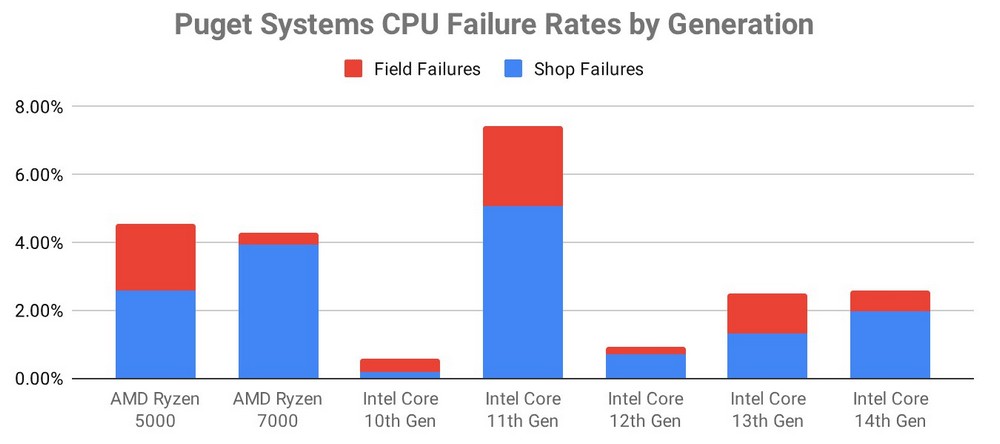
High-end computer maker Puget Systems released statistics, according to which Intel 13th and 14th generation processors have a failure rate of just over 2%, while AMD Ryzen 5000 and 7000 systems have a failure rate of over 4%. This data is in stark contrast to reports from game developers, which cited between 50% and 100% failures of Intel chips.
Puget’s data also points to much higher failure rates in Intel’s 11th generation chips. According to Puget, the 11th generation Intel Core processors had the most failures of all others, at more than 7%. Problems with 11th generation Intel Core processors have not been widely reported.
Puget released the information as part of an announcement to extend the Intel system warranty to three years. Earlier, Intel announced the extension of the warranty on box processors of the 13th and 14th generations for two years. However, Intel did not specifically talk about applying the warranty to off-the-shelf systems from manufacturers, so Puget did so on its behalf.
The company points out that Intel’s 13th and 14th generation processors do have an increased failure rate, but not at an extreme level. Concerns about the reliability of these processors in the future are a much bigger problem than the current failure rate, they said. The company also provided data on failure rates, including AMD Ryzen 5000 and 7000 series processors. As you can see, the 11th Gen Intel chips failed much more often than the Ryzen, but the 13th and 14th Intel processors have a lower failure rate.
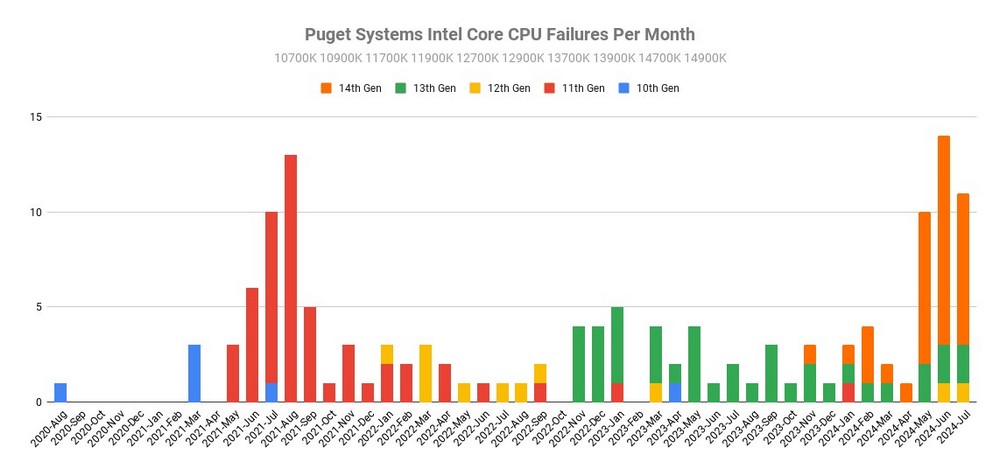
Puget Systems notes that it has not seen such failures since the 11th generation processors. Outages are occurring at the rate of 5 to 7 per month, which she says is hard to classify as a “big problem.” Puget Systems claims that probably due to using conservative BIOS settings and avoiding excessive voltage and power settings, Intel’s 13th and 14th generation processors have a lower failure rate in their systems.
As such, Puget Systems emphasizes the importance of system tuning and management to ensure processor reliability and longevity, while Intel’s 13th and 14th generation processors themselves show a lower failure rate compared to AMD’s Ryzen 5000 and 7000 series processors.
Don't miss interesting news
Subscribe to our channels and read announcements of high-tech news, tes

Samsung Galaxy Fold7: not a smartphone, not a tablet, something more
 0
0 
Samsung Galaxy Fold series of smartphones is notable for its folding design and large display. The new generation model had an even larger screen, advanced cameras, stronger hardware and improved ergonomics.
NVIDIA Blackwell – architecture with new capabilities for AI and content creation
0 
NVIDIA technologies that were previously only available to owners of professional graphics cards are now open to ordinary users. Let’s talk about the capabilities of the Blackwell architecture in the field of artificial intelligence and content creation.
Garmin Instinct Crossover – hybrid smartwatch costs $600 with AMOLED screen, flashlight and sapphire glass smart watches

Garmin Instinct Crossover has a 1.2-inch AMOLED display with RevoDrive analog hands covered with Super-LumiNova luminescent compound.
New EcoFlow with 288 Wh capacity weigh less than 3 kilograms accumulator

EcoFlow has introduced a new line of portable charging stations in Europe, the Trail series. This device has already been on sale in the US